Decking Pedestal Company
Company
Shop By Category
T&Cs
Shop Online
  • Clear materials and product specifications
  • Free tracked Australia-wide delivery over $60
  • 14-day returns

Adjustable Deck Pedestals 24 Pack 30-60mm | Bulk decking pedestals | deck support blocks

Adjustable Deck Pedestals 24 Pack (30-60mm)

$169.99 $203.99 Save $34
  • Dial In The Height
  • Built For Outdoors
  • Screw And Go
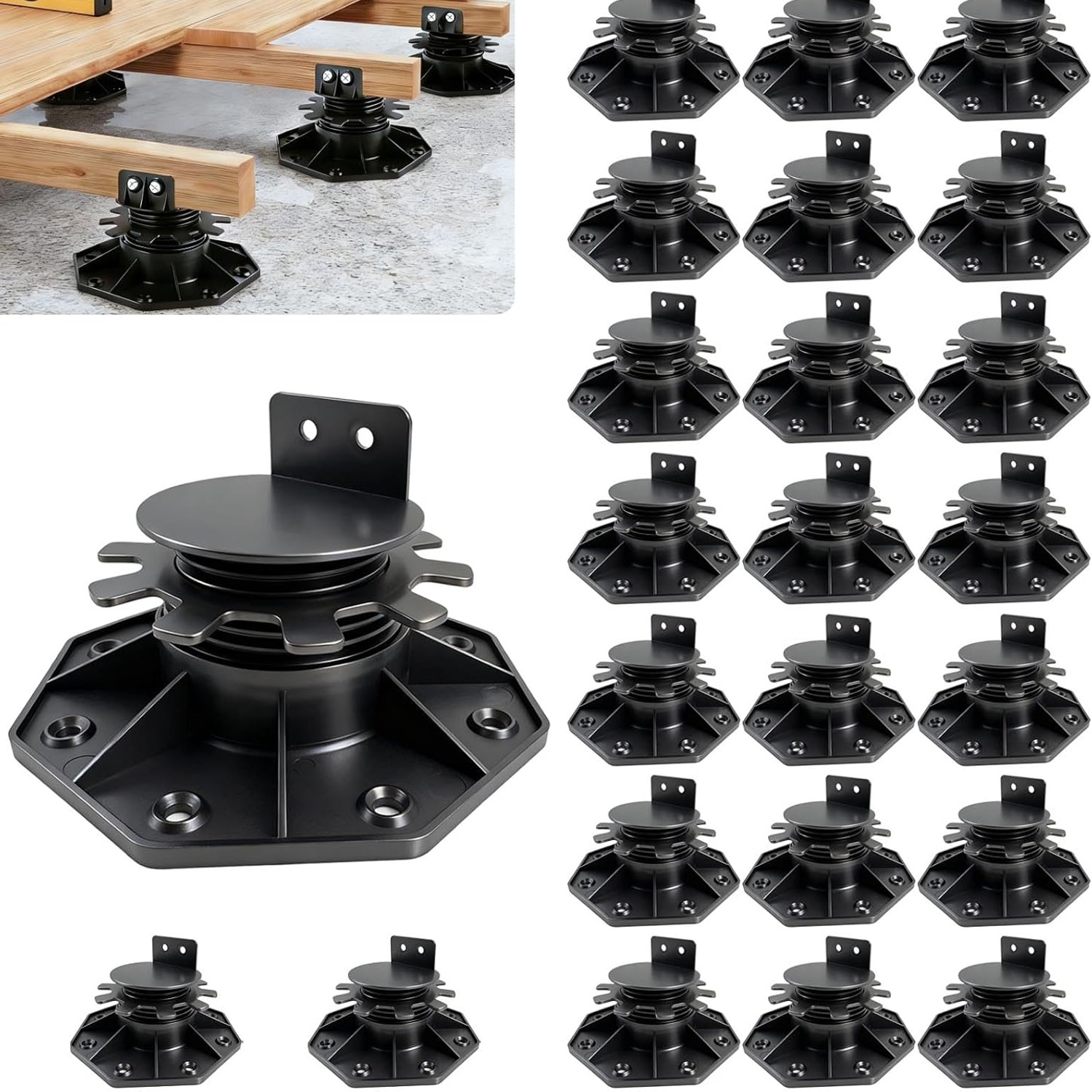
  • 24 In The Box

Price: $169.99 $203.99

  • Free tracked Australia-wide delivery on orders $60+, otherwise a flat $15
  • Pay by card or PayPal, handled by the payment provider
  • 14 days to change your mind, plus your statutory rights
Product specifications
Pack Quantity24 pedestals
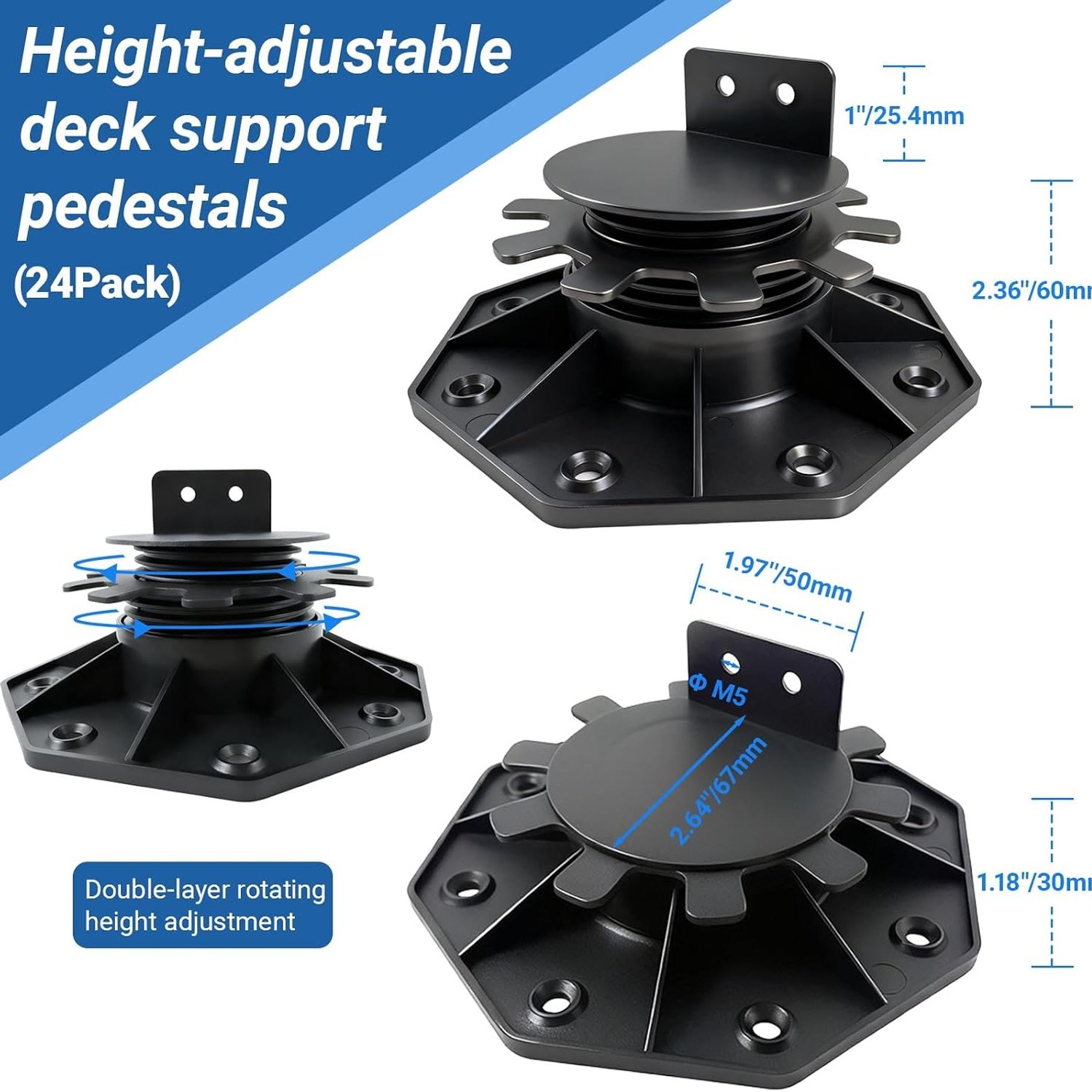
Adjustment Range30mm to 60mm
MaterialHigh-strength PP (polypropylene)
ColourBlack
Package Dimensions25 x 25 x 22.2 cm
Package Weight2.6 kg
Included Components24 x deck blocks (30mm-60mm)
Country of OriginChina
Weight2.6 kg
Shipping & returns

Tracked delivery anywhere in Australia. It is free on orders of $60 or more, and a flat $15 below that.

If it is not right for you, send it back within 14 days of delivery in resaleable condition and we refund the price you paid, including standard delivery. That is a voluntary policy we offer on top of your legal rights. You cover the cost of returning it unless the item is faulty.

If it arrives faulty, damaged or not as described, we put it right at no cost to you under the Australian Consumer Law and the Competition and Consumer Act 2010, return postage included.

Shipping details · Refunds and returns

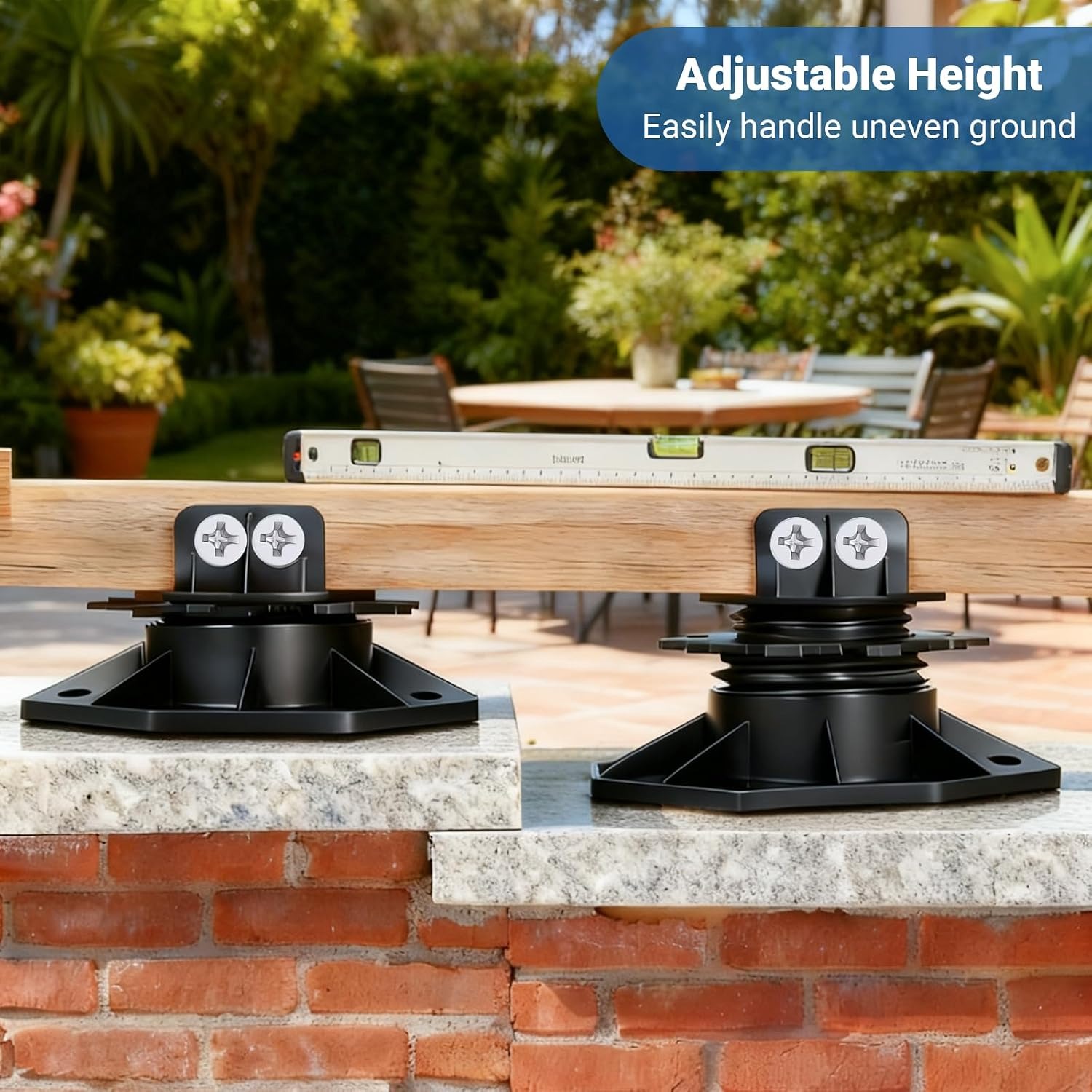
Dial In The HeightEach pedestal tunes from 30mm to 60mm, so a bumpy slab still finishes flat.
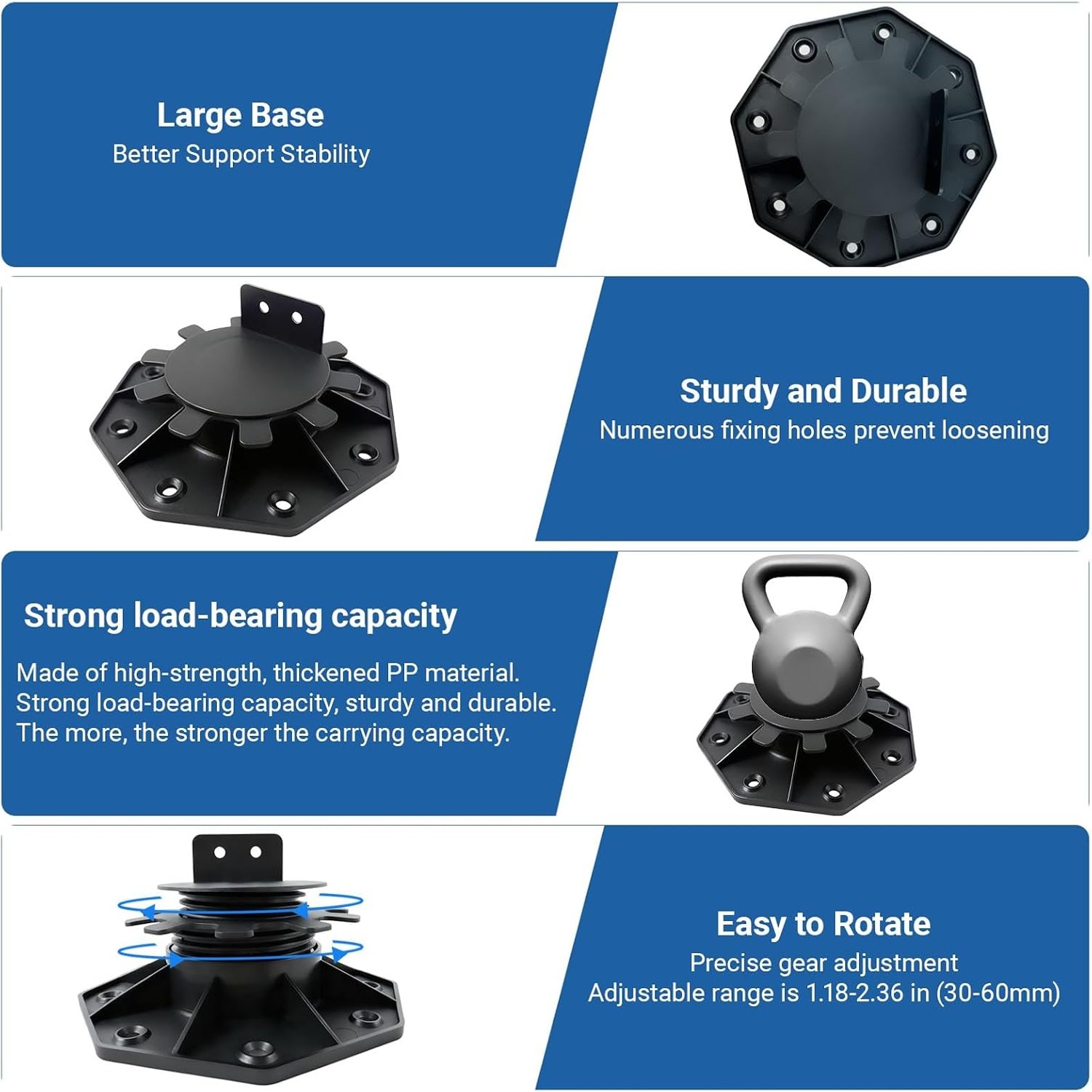
Built For OutdoorsHigh-strength PP resists corrosion and oxidation in sun, rain and frost.
Screw And GoFix through the holes in the top plate straight into the joist, no mortar or digging.
24 In The BoxEnough supports to grid out a small deck, walkway or shed floor in one order.

Build a flat, free-draining platform with adjustable decking pedestals that take the guesswork out of levelling uneven ground with deck support blocks.

A 24 pack of height-adjustable deck support blocks in high-strength PP, tuning from 30mm to 60mm, screw-fixing straight to your joists and lifting timber or WPC clear of wet ground.

Twenty-four adjustable deck pedestals that let you level timber or WPC joists over ground that is never quite flat.

Each support fine-tunes between 30mm and 60mm, so you can chase out dips in a slab without packing shims.

High-strength polypropylene handles sun, rain and frost without rusting, cracking or going brittle the way timber packers and steel can.

The top plate is pre-drilled, so you simply screw through into the joist and move on to the next grid point.

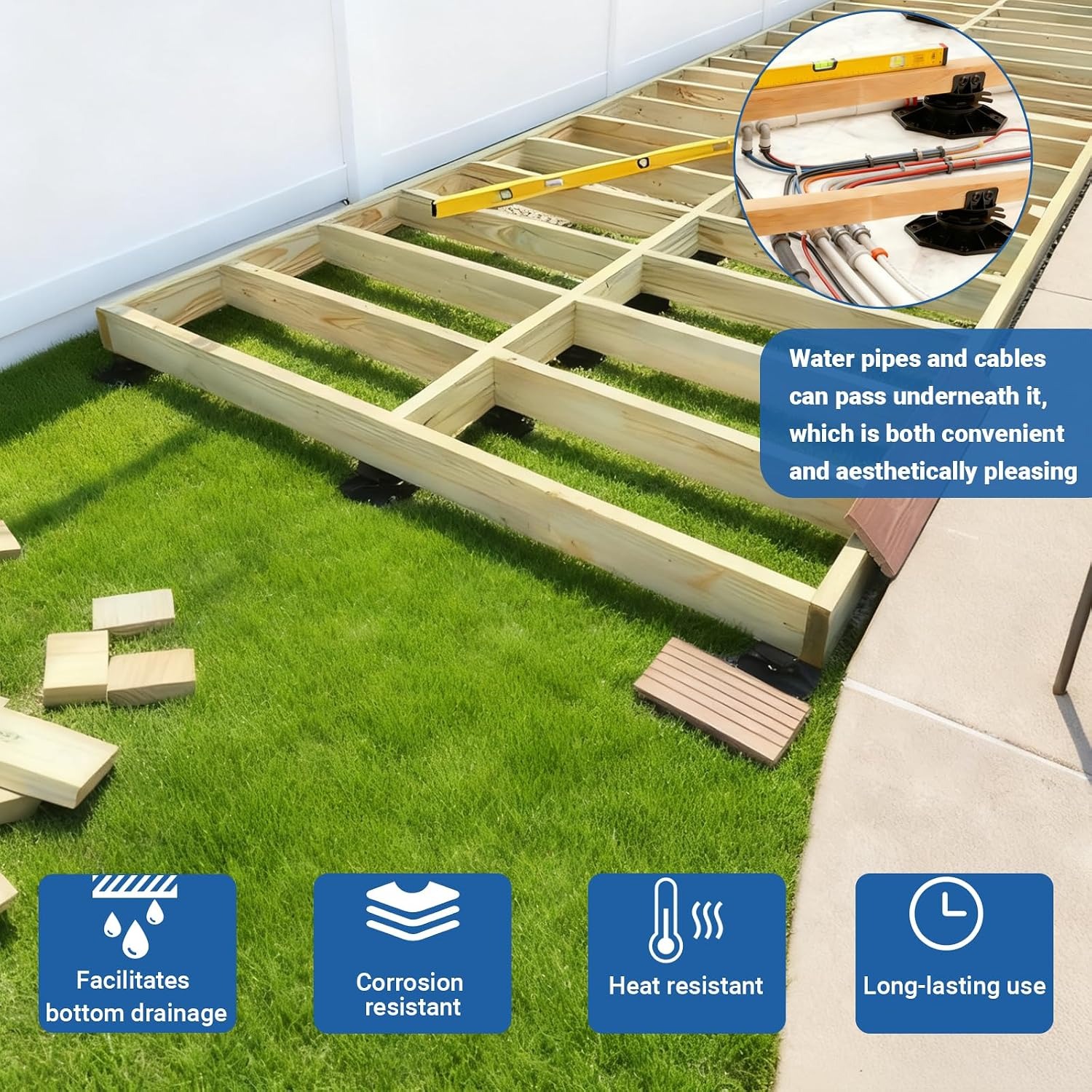
Lifting the frame clear of the ground opens an air gap for drainage, which is the most useful thing you can do for a low deck in a wet climate.

Adjustable Deck Pedestals 24 Pack (30-60mm)

Ground is rarely flat. A concrete slab falls away for drainage, pavers settle at different rates, and compacted soil shifts after a wet winter. If you lay joists straight onto that surface you end up with a deck that rocks, a gap you can see from the garden, and a frame that sits in water every time it rains. Adjustable deck pedestals solve both problems at once by giving every grid point its own independent height setting.

Adjustable Deck Pedestals 24 Pack (30-60mm)

This set contains twenty-four supports, each adjusting between 30mm and 60mm. That range is deliberately low. It is the sweet spot for floating decks over an existing slab, raised walkways, balcony and courtyard platforms, shed floors and greenhouse bases, where you want the frame lifted clear of moisture but you do not want to lose head height or step up awkwardly from the door threshold.

Adjustable Deck Pedestals 24 Pack (30-60mm)

The bodies are moulded from high-strength PP, chosen for outdoor life. The maker notes good corrosion and oxidation resistance and says the material resists deformation, ageing and cracking after long exposure to sunlight, rain and frost. Unlike timber packers it will not rot or feed termites, and unlike steel shims it will not rust and stain the concrete beneath. The rounded base spreads the load across the surface rather than digging a point into it.

Adjustable Deck Pedestals 24 Pack (30-60mm)

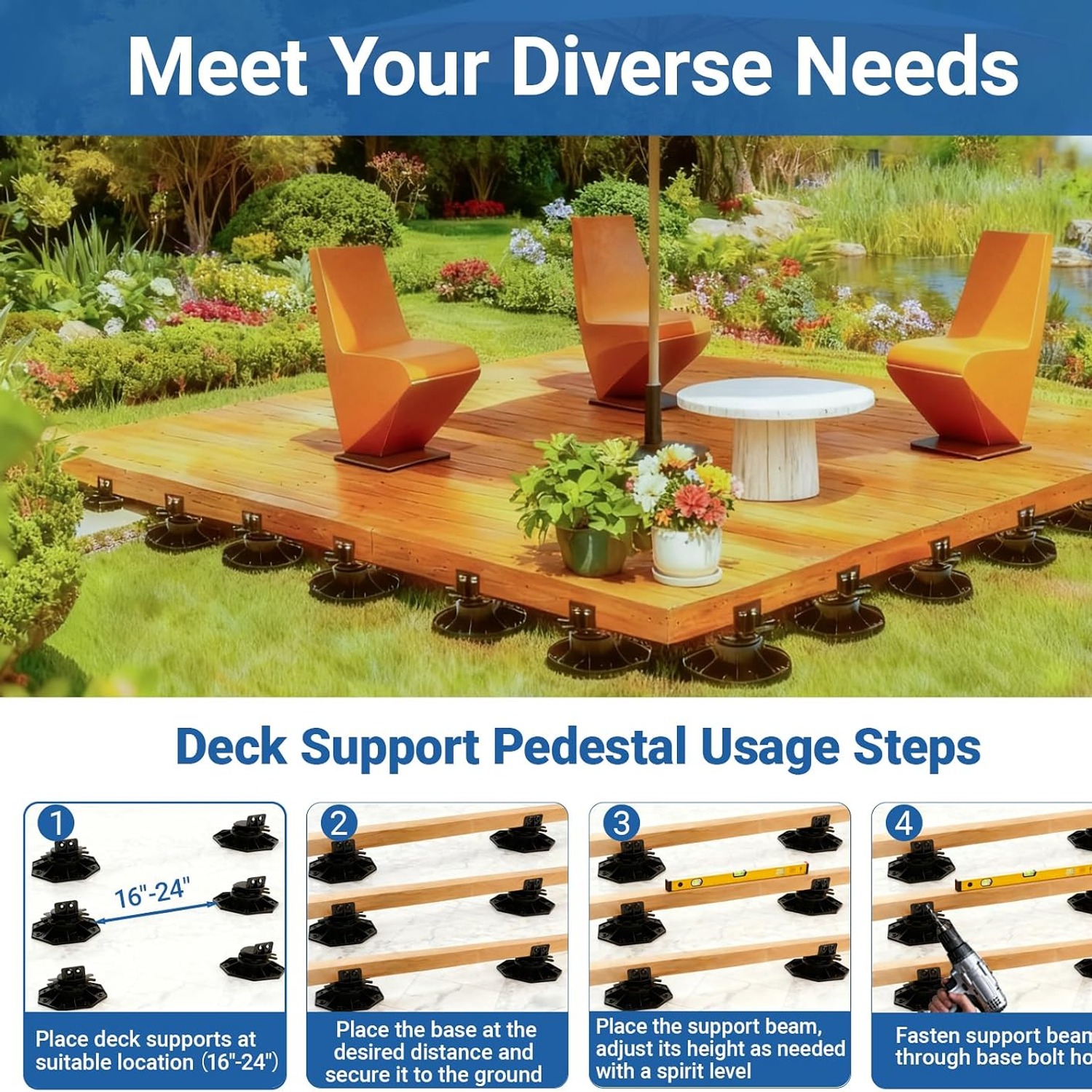
Installation is about as simple as deck work gets. Set the pedestal to roughly the right height, place it under the joist line, then drive screws through the small holes in the upper plate into the joist so the frame and the support act as one. Because the height can still be changed after installation, you can come back a season later, after the ground has settled, and bring everything back to level without pulling boards up.

Adjustable Deck Pedestals 24 Pack (30-60mm)

The pedestals suit treated timber joists, WPC decking joists, stone, engineered mesh flooring, greenhouse floors and pipe runs. For most small projects they are a quicker, cleaner alternative to pouring concrete piers or cutting hardwood posts. No load rating in kilograms is published by the maker, so for anything carrying heavy or unusual loads, space the supports closer and seek advice from a builder or engineer.

Not sure yet? That is fine.

Fibre, weight and colour are hard to judge from a photograph, and a piece has to feel right in the hand. If it is not right for you, send it back within 14 days of delivery in resaleable condition and we refund the price you paid, including standard delivery. That is on top of your Australian Consumer Law rights if anything arrives faulty.

If it turns up faulty, damaged or not as described, that is on us. The Australian Consumer Law and the Competition and Consumer Act 2010 covers you, and we pay the return postage. Read the full detail on our refunds and returns page, or ask us anything before you order.

Frequently Asked Questions

What exactly is in the box?

You get 24 adjustable deck support pedestals, each with an adjustment range of 30mm to 60mm. They arrive in a package measuring roughly 25 x 25 x 22.2 cm and weighing 2.6 kg. Fixing screws are not listed among the included components, so plan to supply your own.

How do adjustable deck pedestals actually work?

Each pedestal has a threaded body that screws up or down to change its overall height. You set each one to suit the ground under that particular point, so a surface that falls away or dips can still carry a perfectly flat frame. The top plate then screws to the joist so the two move as one unit.

What is the height range?

From 30mm to 60mm, which is about 1.18 inches to 2.36 inches. That makes these low-profile supports rather than tall ones. They are meant for lifting a frame slightly clear of a slab or ground, not for building a raised platform.

Can I use these to build a deck a foot off the ground?

No. The maximum height here is 60mm, so these are for low installations only. If you need more clearance you want a taller pedestal system or a conventional bearer and post frame. These are low profile deck pedestals for slab-level work, not for elevated structures.

What material are they made from?

High-strength PP, which is polypropylene. The maker describes it as corrosion and oxidation resistant, and says it will not easily deform, age or crack with long exposure to sunlight, rain and frost. It will not rust and it will not rot.

Will they survive hot Australian sun?

The material is specified for outdoor use and the maker states it resists ageing and cracking under prolonged sun, rain and frost. Like any plastic component, it will last longer if it is not left to bake unshaded with no deck above it. Once the boards are down, the pedestals sit in shade most of the time.

Are they termite proof?

Polypropylene is not a food source for termites, so the pedestals themselves are not at risk the way timber packers are. Your joists and boards are a different matter and should be treated timber or a termite-resistant material. Keeping the frame off the soil with these supports also helps by removing the damp contact point.

How many pedestals do I need for my deck?

It depends on your joist spacing and the loads you expect. As a rough starting point, supports are often placed every 400mm to 600mm along each joist and at every joist end or join. Measure your frame, mark the grid on paper, and count the points before ordering.

Is 24 enough for a typical small deck?

For a compact platform of a few square metres at close spacing, usually yes. For anything larger, order a second pack. It is always better to have a few spare than to be short halfway through a build.

Do they work with WPC decking?

Yes. The maker lists WPC flooring joists among the compatible materials, alongside treated timber, stone, engineered mesh flooring and greenhouse floors. These are a sound pick if you are after pedestals for WPC decking on a low slab.

Can I use them on grass or soil?

They work best on a firm, stable surface such as concrete, pavers or well compacted road base. On soft soil the bases can sink unevenly over time. If you must build over soil, lay a paver or compacted pad under each support point first.

Will they work on a sloping concrete slab?

That is one of their main jobs. Most slabs are poured with a fall for drainage, and the 30mm adjustment range lets you take up that fall across a small area. For a steep or long fall, check that the difference across your deck stays within the range before buying.

How do I fix them to the joists?

The upper plate has small holes in it. Position the pedestal under the joist, then drive screws up through those holes into the timber so the frame and the support are locked together. Use outdoor-rated screws of a length that bites well into the joist without punching through the top face.

Do I need to fix them down to the slab?

The maker does not specify anchoring to the ground, and many low floating decks rely on weight and the connected frame for stability. If you are in a windy, exposed spot or building something light, consider anchoring the frame perimeter for peace of mind. A local builder can advise for your conditions.

What load can each pedestal carry?

The maker does not publish a figure in kilograms, so we will not quote one. The bullets describe a strong load-bearing base with a rounded bottom for stability, but no rated number is given. For heavy loads such as spas, planters full of soil or outdoor kitchens, get engineering advice and space supports more closely.

Can I adjust the height after the deck is built?

Yes, and that is one of the real advantages. The maker states adjustments can be made after installation so the platform can be brought back to level if the ground settles. Access is easiest around the perimeter or through a removable board.

Do they help with drainage?

They do. Lifting the frame off the ground creates an air gap so water can run away and air can move underneath. That gap is the single most useful thing for a low deck in a wet climate, and it is why many buyers look for deck pedestals that drain well.

Will they stop the deck from rotting?

They remove constant ground contact, which is where most low decks start to go. They cannot stop rot on their own. Use treated or naturally durable timber, keep debris out from underneath, and make sure water drains away rather than pooling.

Are they a replacement for concrete piers?

For low, light structures such as floating decks, walkways, shed floors and greenhouse bases, they are a practical alternative that saves digging and mixing. For habitable structures, decks carrying significant height, or anything subject to building approval, follow your local rules and use the specified footing system.

Can I use them under a garden shed floor?

Yes, shed floors are one of the listed applications. Grid the supports under the bearers, level them, and you keep the floor off damp ground. People often describe this as a sound supports for shed flooring approach because it is quick and needs no concrete.

Do they make noise or move underfoot?

Once screwed to the joists and correctly levelled, the frame behaves as a single unit and should feel solid. Rocking usually means one or more supports are not quite touching, so go around and fine-tune the heights. The rounded base design is intended to sit stable and resist tilting.

What tools do I need?

A drill or driver, a spirit level or laser level, a string line, a tape measure and outdoor-rated screws. A rubber mallet is handy for nudging supports into position. Nothing specialised is required.

How long does installation take?

For a small platform with 24 supports, most people with the frame already built are looking at an afternoon. Setting the string lines and getting the first row level takes the longest. After that, each pedestal goes in quickly.

Can I use them on a balcony or rooftop?

They suit balcony and courtyard platforms where the surface is sound and the structure can take the load. Check the load limits of the balcony itself and any body corporate or strata rules before you start. Protect waterproof membranes with a pad under each base if required.

Do they come in other heights?

This listing covers the 30mm to 60mm range in a 24 pack. Other ranges may be available in the wider deck pedestal category. If you need more lift, look at a taller adjustable range rather than stacking these.

How do I clean and maintain them?

Sweep or hose grit and leaf litter away from the bases so water keeps draining. Check the screws and the height settings after the first season and after heavy rain. No painting, oiling or sealing is needed.

What colour are they?

Black, which disappears nicely into the shadow under a deck. There is no colour choice listed for this pack. Once the boards are down, you will barely see them.

How are they delivered and how long does it take?

They ship as a single parcel of about 2.6 kg, so delivery is straightforward to most addresses. Timing depends on your location and the courier network serving it. You will receive tracking details once the order is dispatched.

Would these make a sensible gift?

For a keen DIY builder planning a deck or shed project, yes, they are a genuinely useful gift rather than a novelty. They pair well with a decking screw pack or a decent level. Just check which height range the project needs first.

What if they are not right for my project?

If the height range does not suit, the pack arrives damaged, or the product is not as described, contact us and we will sort it out. Keep the packaging and the unused pedestals in resaleable condition where possible, as that makes a return simpler. Our returns terms set out the full detail and timeframes.

Adjustable Deck Pedestals, A Practical Buyer's Guide

6 min read Decking Pedestal Company

The problem with building on real ground

Nothing outside is flat. A concrete slab is poured with a fall so water runs off. Pavers settle unevenly once the soil under them dries out and swells again. Compacted base shifts after a wet season. None of this matters until you try to lay a deck frame on it, and then it matters a lot.

Lay joists straight onto the surface and you get three headaches. The deck rocks where the ground dips. The timber sits in whatever water pools there, which is where rot and insect damage usually start. And a stubborn gap appears along one edge that you cannot hide with trim.

Builders have dealt with this forever by packing out the low spots with offcuts, shims or scraps of paver. It works for an afternoon. Then the timber packer swells, the paver scrap cracks, and the deck is uneven again.

Adjustable deck pedestals fix the issue at the source. Every support point gets its own height setting, so the ground can be as wonky as it likes and the top of the frame still finishes dead flat.

How these supports work

Each pedestal is a moulded plastic base with a threaded body. Twist it and the overall height changes. This pack adjusts anywhere between 30mm and 60mm, which is roughly 1.18 to 2.36 inches.

That is a low range on purpose. These are not for building a raised deck on posts. They are for the far more common job of lifting a frame slightly clear of a slab, a paved courtyard, a shed pad or a balcony surface. You get drainage and an air gap without losing head height or creating an awkward step up from a doorway.

The top plate is pre-drilled. You position the pedestal under the joist, set it to height, then drive screws up through those holes into the timber. From that moment the support and the frame behave as one structure, which is what stops the sway and tilt you get with loose packers.

The bodies are high-strength PP, better known as polypropylene. The maker specifies good corrosion and oxidation resistance and says the material does not easily deform, age or crack after long exposure to sun, rain and frost. In plain terms, it will not rust and stain the slab, it will not rot, and termites have no interest in it. The base is rounded underneath, which spreads the load across the surface rather than concentrating it at one point.

One thing worth saying plainly: the maker does not publish a load rating in kilograms for these. We will not invent one. The copy describes strong load bearing and a stable base, and that is as far as the facts go. For normal foot traffic on a low platform that is usually fine. For a spa, a stone bench, a full outdoor kitchen or anything unusual, talk to a builder or engineer and space your supports closer.

Who these suit

This pack is a good fit if you are doing any of the following.

Laying a floating deck over an existing concrete slab that has a fall on it. This is probably the single most common use. The 30mm of adjustment usually covers the drainage fall across a small to medium area.

Building a shed or greenhouse floor that you want off damp ground. Grid the supports under the bearers and you get a dry, level floor with no concrete work.

Putting a timber or WPC platform over pavers in a courtyard or on a balcony, where you need a clean flat surface but cannot or do not want to lift the existing material.

Running a walkway or a small multi-level landing across ground that is close to flat but not quite there.

They are less suitable if you need real height, if you are building over soft uncompacted soil with no pad under each point, or if the structure is subject to building approval with a specified footing system. In those cases use the right tool for the job.

Working out how many you need

Start with your joist layout. Supports usually go under every joist at regular intervals, plus at every joist end and every join. Spacing between 400mm and 600mm along the joist is a common starting point for light residential use, closer if your boards are thin, your timber is springy, or you expect heavy loads.

Sketch the frame on paper and mark every support point. Count them. Then add a few spare. Running three pedestals short on a Sunday afternoon is a genuinely annoying way to end a project.

Twenty-four supports covers a compact platform at tight spacing, or a slightly larger one at wider spacing. If your project is bigger than a few square metres, order two packs from the start.

Getting them in straight

Set up string lines first. Pick your finished height, run lines across the area at that level, and work to them. Trying to level pedestal by pedestal with a short spirit level is slow and tends to drift.

Set the corner supports first and check them against each other with a long level or a laser. Then work along each line, bringing each pedestal up until it just touches the underside of the joist. Just touching is the goal. Over-tightening one support lifts the joist and takes the weight off its neighbours, which is exactly what causes rocking later.

Screw through the top plate holes into the joist with outdoor-rated screws. Choose a length that bites well into the timber without punching through the walking surface.

Walk the deck before you fix the boards. Any rocking is easier to chase out now than afterwards.

Care, and the season-two check

There is not much maintenance to speak of. The material needs no paint, oil or sealer. What it does need is for water and air to keep moving.

Sweep or hose grit, soil and leaf litter away from the base areas every so often. Build-up blocks drainage and slowly turns an air gap into a damp bed, which defeats the whole point of lifting the frame.

Then there is the season-two check, which is the part most people skip. Ground settles. Slabs move a little. After the first wet season, go around the perimeter with a level and see if anything has shifted. Because the height stays adjustable after installation, a quick twist brings the deck back to level without pulling boards up. That ability to re-level later is one of the real advantages over a fixed pier.

Keep an eye on the screws too. Timber shrinks and swells with the weather, and a fixing that was tight in autumn can loosen by the following summer.

The short version

If you are building low and the ground is uneven, adjustable deck pedestals save you time, shims and swearing. This pack gives you 24 supports with a 30mm to 60mm range, moulded in weather-resistant polypropylene, screwing straight to your joists.

They suit floating decks over slabs, shed and greenhouse floors, courtyard and balcony platforms, and short walkways. They do not suit raised decks, soft unprepared soil, or heavy unusual loads without advice.

Measure your grid, count your points, order a few spare, and set up string lines before you start. Do that and you will have a flat, free-draining platform that stays flat.

Browse the shop

Not sure how many you need?

Sketch your joist grid, count the support points, and order a pack with a few spares so you are not stopped mid-build.

Ask us a question

Page summary

This is a 24 pack of adjustable deck pedestals, supplied in black. Each support adjusts in height from 30mm to 60mm and is moulded from high-strength PP, described by the maker as resistant to corrosion, oxidation, deformation, ageing and cracking in sun, rain and frost. The top plate carries small holes so the pedestal screws directly to a joist, and the height can be re-adjusted after installation if the ground settles. The rounded base helps spread load. Typical uses include low floating decks, patios, multi-level decks, walkways, shed and greenhouse floors, WPC and treated timber joists, stone and engineered mesh flooring. Package measures 25 x 25 x 22.2 cm and weighs 2.6 kg. No load rating in kilograms is specified in this record.